

A website for Agriculture & Food
A ready theme, management panel, hosting, SSL and a technical SEO foundation for Agriculture & Food in one package. Choose your industry at setup; ready service suggestions are added in one click, and you can write your own services too.
- 9ready service suggestions
- SEO + GEOindustry-specific content
- 1 business dayon the fastest package
Quick quote
Your Agriculture & Food website: get a quote
Fill in four fields; we'll get back to you the same day and build your site together.
- Same-day reply
- Live in 1 business day with a ready theme on the fastest package
- SSL, hosting and daily backups included
Ready at setup
Ready at setup: service suggestions
When you choose your industry, the services below are added to your site in one click; you change their names, order and descriptions from the panel.
- Fresh fruit and vegetables
- Olives and olive oil
- Milk and dairy products
- Honey and bee products
- Dry foods and pulses
- Seedlings and saplings
- Delivery from the farm
- Wholesale product sales
- Farm visits
Sites we've put live in this industry
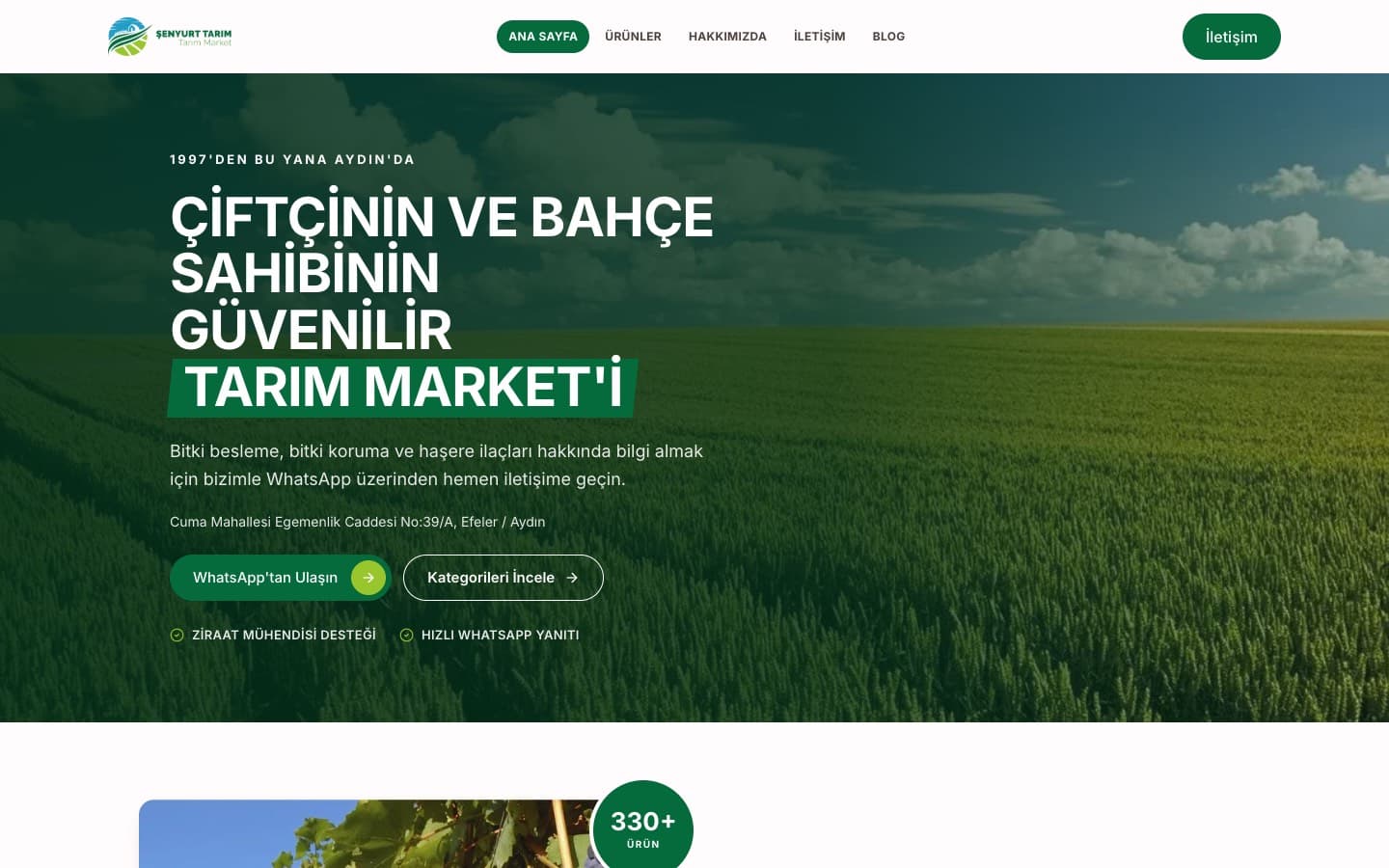
SEO & GEO
SEO & GEO for agriculture and food producers
On a separate page we explain which items make up our SEO and GEO work for this industry, search intent by sub-area, and frequently asked questions.
- A page per product group
- Consistent contact details
- Question-and-answer content
- Technical crawl
- Structure for AI
- Measurement and monthly report
Guide
What should an agriculture and food producer website look like? Products, place of production and ordering
A person or business buying from a producer for the first time usually looks online first. They want to see what the product is, where and how it's produced, when it's available and how to order. An agriculture and food producer website gathers the answers to these questions at one address, in the order you decide. In this post, we explain what such a site should include, how buyers search for producers and what builds trust.
Read the full articleClose the article
What is an agriculture and food producer website, and why do you need one?
An agriculture and food producer website is a set of pages under the business's own control that brings its product groups, place of production, sales and delivery terms and contact options together at one address. A market stall is set up for a day; a social media post gets lost in the feed. A site, by contrast, is always reachable and can be kept up to date: product groups on their own pages, delivery information under its own heading, the business name and address at the bottom of every page. It's also the first place a shop or restaurant looking for a new supplier checks.
Which pages should an agriculture and food producer site have?
The home page should say at a glance what you produce and where you produce it.
- Product group pages: each group on its own page, with what the product is, packaging options, real product photos and how to order.
- Place of production: your own photos of the farm, orchard or facility, and a plain description of how production is done.
- Season and availability: which product is available in which period; a way to get information out of season.
- Orders and delivery: the areas you deliver to, delivery days, minimum order quantity and storage advice.
- Wholesale: terms of sale to businesses and how to request a quote.
- Contact: address, map, phone and a request form that asks for the product and quantity upfront.
Even if you'd rather not put prices on the site, explaining what they depend on (quantity, packaging, delivery location) saves you answering the same question again every time.
How do buyers search for producers?
Searches come with the product name, often together with a place name or a word such as "from the producer" or "wholesale"; only the page for that product group can answer such a search. On the page, buyers look for where the product is produced, how it's packed, how delivery works and information showing that the business really exists. Search engines and AI tools read the text describing an image, not the image itself; so every product group should have a plain description of a few paragraphs, and every image a short description. This isn't a ranking promise; it's the groundwork buyers need to be able to find you when they search.
Most buyers open the site on their phone, and they often arrive not at the home page but at the page for the product they're looking for. So each product group page should make sense on its own: what the product is, when it's available, delivery information and how to get in touch should all be on the same page. Short posts about the harvest season, storage advice and how production is done also answer buyers' questions and link to the product pages.
Information that builds trust, and points to watch
When making a decision, buyers look at verifiable information, not bold claims.
- Real details: business name, full address, phone and your own photos of the place of production; stock images undermine trust in this industry.
- Certificates: information on production method, certification or geographical indication is written only if it's based on a valid certificate.
- Health claims: sentences that attribute a health effect to a product are left out of the texts.
- Being up to date: availability, pricing terms and delivery days are kept current on the site.
- Legal texts: privacy notice, cookie information and form consents, complete.
If you're going to show businesses that are your customers as references, get their permission before publishing their names.
Your agriculture and food website with Octofly
Every package has a price known upfront; the structure needed for product group pages, the gallery, FAQs and the request form is ready. When you choose agriculture and food as your industry at setup, ready service suggestions such as olives and olive oil, milk and dairy products, and delivery from the farm are added in one click. The design is prepared for you. Mobile-friendliness, SSL, hosting and daily backups are included; the page title, description and canonical URL are generated automatically on every page. You update your product groups, gallery and FAQs yourself from the panel. If your content is ready, your site goes live in 1 business day with a ready theme on the fastest package. We're your single point of contact for design, hosting and technical work. Get in touch; we'll get back to you the same day.
Questions about Agriculture & Food websites
Do our product groups, such as olive oil, dairy products and honey, come ready at setup?
When Agriculture & Food is selected, suggestions such as fresh fruit and vegetables, olives and olive oil, milk and dairy products, honey and bee products, dry foods and pulses, seedlings and saplings, delivery from the farm, wholesale product sales and farm visits are added in one click. You select what you produce and write their descriptions from the panel to fit your products.
Can we sell our products and take payments through the site?
No; the site has no virtual POS (card payment gateway) or online payment, and no package includes e-commerce. Order requests come in through a form, a WhatsApp line and click-to-call, and incoming requests are kept in the inbox in the panel; you take payment with the method you already use.
Our products are seasonal; how should we show this on the site?
State clearly on each product's own page when it's available, and show how to get information out of season. You update product descriptions and availability information from the panel whenever you like. Outdated information leaves buyers calling for nothing.
What can we write about certification and production methods on product pages?
Write only information that's based on a valid certificate; state your certificate's name and scope exactly as they are. Avoid wording that attributes a health effect to a product. The ready suggestions at setup are only product group names; no ready text stating certificates or qualities is included.
How should we add product and production site photos?
Use real photos of your own products and place of production; stock images undermine buyers' trust. The gallery module is in every package, and photos are automatically converted to lightweight formats on upload. Writing a short description for each image helps search engines understand it.

Your Agriculture & Food website: take the first step
We can set up the same infrastructure for your Agriculture & Food business.